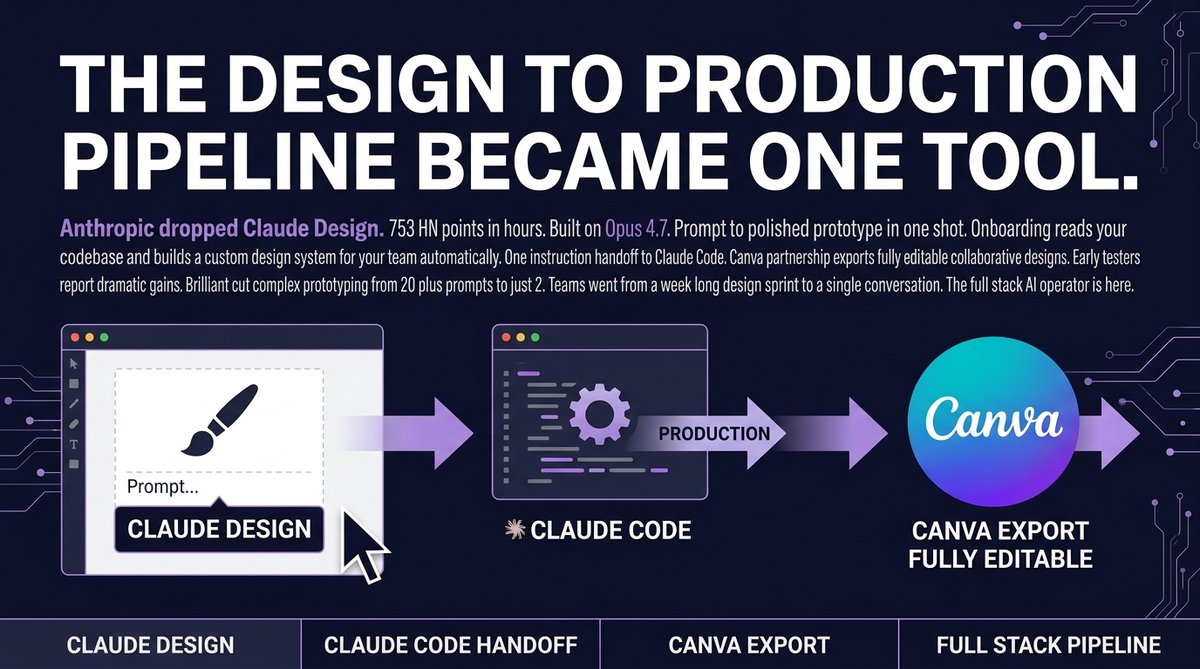
Anthropic shipped Claude Design today. It hit 753 points on Hacker News within hours. That’s a big number for a product launch. Most people in that thread are arguing about the wrong thing.
This is not a design tool for designers. It’s a design tool for operators who could never justify hiring a designer in the first place. That’s a much bigger deal than the thread suggests.
The Real Story Is Scope Expansion
Here’s the thing. Before today, there was a whole category of work that never got design attention. Internal tools. MVPs. One-pagers for internal presentations. Quick prototypes to show stakeholders something before a real sprint. These things existed in a design desert. They looked like they were built in 2007, or nobody built them at all because the time cost was too high.
Claude Design closes that gap. Not by making designers irrelevant. By making design accessible to the long tail of work that was never going to get it. For small agencies and solo operators, this changes what you can ship without outsourcing or stretching a developer thin doing CSS work they don’t enjoy.
One team on the HN thread said they went from a week-long design sprint to a single conversation. Brilliant reported cutting complex prototyping from 20-plus prompts to 2. Those numbers are for real work, not toy demos.
The Homogenization Concern Is Overblown For Most Use Cases
The thread is full of hand-wringing about AI making everything look the same. Fair point for brands that need differentiation — consumer products, VST plugins for musicians, anything where visual identity is a competitive moat. That fight is real.
But here’s my take. That argument applies to maybe 5 percent of the design work being done right now. The other 95 percent is internal tools, MVPs, and quick prototypes that never would have had a design review in the first place. For that work, homogenous and fast beats artisanal and slow every time. Internal tools do not need to stand out. They need to work and not look like a relic from 2015.
The designers sweating over homogenization are fighting a real battle — for their own portfolio work. For everyone else, this is scope expansion, not creative extinction.
The Design-to-Code Pipeline Just Collapsed
Here’s what nobody is talking about enough. The Claude Design to Claude Code handoff is a single workflow now. You create in Claude Design. It bundles your design system and passes everything to Claude Code with one instruction. You ship. No handoff document. No losing context between design and development.
For small teams doing fast work, this is a real change. I have been running design and code as separate workflows because there was no clean bridge between them. That bridge just got significantly shorter.
The Canva export matters too. Designs export as fully editable, collaborative Canva files. If you’re already in the Canva ecosystem and most small agencies are, the loop closes. AI generates. Humans refine. Nobody starts from scratch.
What To Do This Week
If you’re already running Claude Code, add Claude Design to the workflow. Not for client-facing work that needs real differentiation. For the internal tools, the quick prototypes, the pitch materials that always look worse than they should because design time was never budgeted.
Start with one piece of work that would normally get minimal design attention. Run it through Claude Design. Refine with chat. Export to Canva or hand off to Claude Code. See where the quality breaks down and where it holds.
Track what you’re using it for and what the output looks like after one or two refinement cycles. The tool is new. The design system will need tuning. But the workflow is real, and it is faster than anything I have seen for this specific scope of work.
This is not the death of design. This is design for the 95 percent that never got any.
Sources:
– Anthropic announcement: https://www.anthropic.com/news/claude-design-anthropic-labs
– Hacker News discussion: https://news.ycombinator.com/item?id=47806725