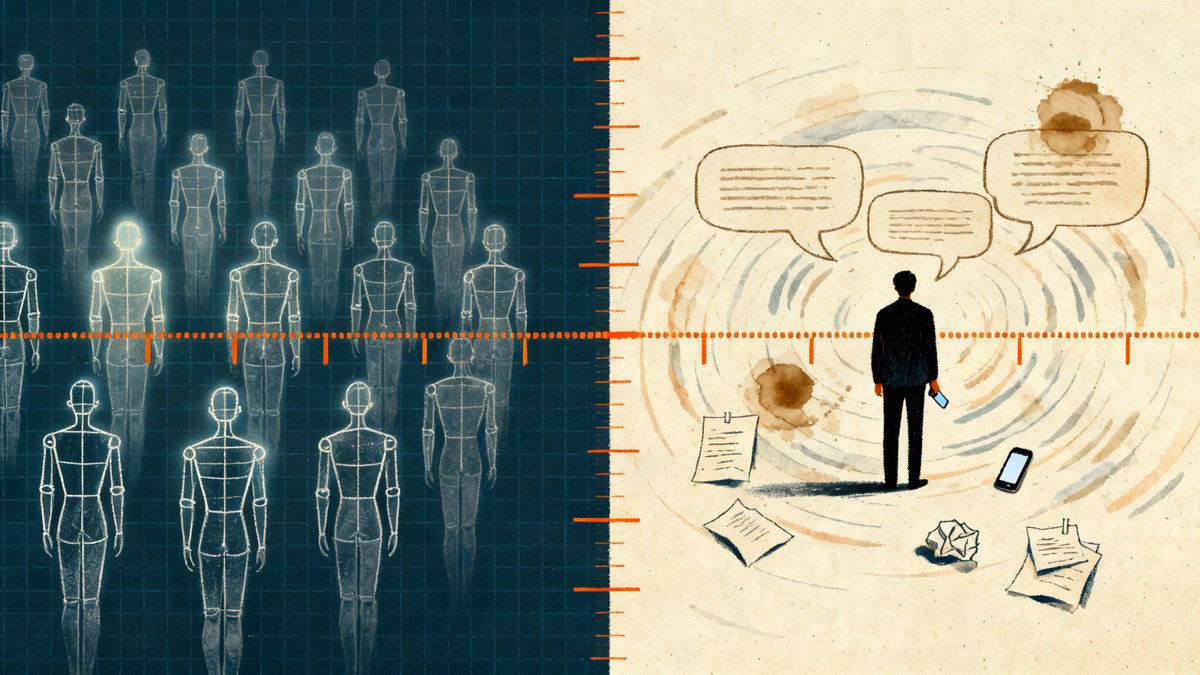

User simulation matched real human choices 53% of the time. That’s the headline result from a 2026 study, summarized on r/artificial, which pushed LLMs through 78 choice tasks drawn from 28 real-world studies and checked whether the simulated preference agreed with the majority human pick.
The Reddit writeup called it coin-toss accuracy for two-option questions.
Around that uncomfortable number, researchers shipped a wave of new evaluation frameworks — realsim, Eval4Sim, and RealUserSim.
While Apple and others pushed synthetic training environments to 1,000 worlds at a time. The field stopped assuming fake users behave like people. Started measuring the gap instead.
I run a small AI automation agency. Default eval at my size: a handful of handwritten personas and a gut check after each deploy, which tests whether the bot survives my own imagination of the user.
The research says that imagination is the broken part, and the audits are public and free to read.
User Simulation Evaluation Frameworks Compared
realsim comes from a 2026 paper titled “Synthetic Users, Real Differences,” and it takes what the authors call a “distributional view of real vs. simulated dialogues along 8 dimensions.” The question isn’t whether one fake conversation looks plausible.
It’s whether whole populations of real and simulated dialogues line up, across three levels of user behavior:
– Communicative functions. User intent and feedback
– User states. Emotion, domain-specific knowledge, personal context
– Surface form. Message length, linguistic attributes, and errors
They instantiated the framework with 1,000 multi-turn, task-focused real user-chatbot dialogues spanning 16 chatbot application domains.
Surface form is the tell. Real people typo. They send three messages where one would do, and they drag in personal context nobody asked for. Handwritten personas don’t do any of that. So an eval built on clean personas will pass a bot your actual customers quietly hate.
Testing tidy personas is like inspecting a roof in a dry summer. You learn nothing about where it leaks.
If you can’t say how your test users differ from real ones along even one of those 8 dimensions, your eval results are a story you tell yourself before launch.
Real Conversations Beat Invented Personas
RealUserSim is the paper I keep rereading from this pile.
It claims “the first user simulation framework grounded in real behavioral data,” and the team backed that claim by mining 14,000+ authentic human-LLM conversations from the WildChat corpus and extracting 7,275 executable behavioral profiles to replace fictional personas in agent evaluation.
7,275. Not a number anybody rounds off for a pitch deck.
Two modules run the thing: a profile construction pipeline that builds behavioral models from real user data. And a grounded simulation pipeline whose fidelity gets checked by a Paired Trajectory Turing Test.
Read that as a confession. When researchers would rather mine 14,000+ real conversations than write “You are a busy mom from Ohio,” they’re telling you the invented persona was the weak link all along.
Two companion frameworks attack the measurement side. Eval4Sim scores simulated persona conversations against human conversational patterns on three dimensions. Adherence, consistency, naturalness. Adherence gets measured via dense retrieval with speaker-aware representations, consistency via authorship verification, naturalness via distributions from dialogue-focused Natural Language Inference, with PersonaChat as the human reference corpus. It’s corpus-agnostic, so any persona-annotated conversational dataset can serve as the reference. A separate paper on generative user simulators for conversational recommendation proposes what it calls the “first evaluation protocol” for that setting, split into five independent tasks, with simulator outcomes compared against human data curated from four different platforms.
Shared ingredient across all three: a human reference corpus. A simulator with nothing real to compare against is unfalsifiable, which is the polite word for useless.
1,000 Synthetic Worlds, a Million Agents
One branch of research audits the simulators.
Another bets big on them.
Apple’s paper on Environment-free Synthetic Data Generation for API-Calling Agents (S.
Lee et al., 2026) throws out the fake sandbox and uses LLMs as “on-the-fly digital world models” for stateful API environments. Four steps: an LLM generates diverse tasks solvable with the provided APIs, a teacher agent iteratively solves each task, an LLM simulator produces synthetic API responses conditioned on context and history. And an LLM judge filters trajectories to keep quality up.
Fine-tuning on the output yields significant gains for API-calling agents on the AppWorld and OfficeBench benchmarks, which cover both information-retrieval and state-changing tasks.
Agent World Model (AWM) goes further, generating 1,000 fully synthetic environments with executable tool infrastructure, then testing generalization on three external benchmarks: a verified version of τ²-bench, BFCLv3, and MCP-Universe.
The BFCLv3 numbers deserve a slow read.
An 8B-parameter model fine-tuned in AWM climbed from 53.83 to 65.94 overall, beating an LLM-simulator baseline at 52.53 and an EnvScaler baseline at 36.83.
On MCP-Universe, a 14B model trained in synthetic environments hit 12.29% against 8.38% for the base model.
Both halves of that MCP-Universe result matter.
Relative gain is real.
And 12.29% is still an agent failing most tasks it’s given.
When a vendor waves a synthetic-training win at you, ask for the absolute score, not just the delta.
Social side: the open-source OASIS project simulates up to one million LLM agents behaving like users on platforms resembling Twitter and Reddit, complete with interest-based and “hot-score”-based recommendation algorithms, built for studying information spread, group polarization. And herd behavior in synthetic social environments.
A full fake internet. Downloadable.
How to Run User Simulation Evals Without a Research Team
The one piece of this stack a small shop can realistically stand up without hiring anyone is ActorSimulator in AWS’s Strands Evaluations SDK.
It wraps a Strands Agent configured to behave as a realistic user persona. You define test cases with input queries and task descriptions that capture user goals. And it handles profile generation, conversation management. And goal tracking automatically, then feeds the resulting transcripts into your evaluation pipeline for metrics like helpfulness scores and goal success rates.
Structured user simulation from a vendor whose blog post, unlike the papers, includes no math prerequisites.
Full disclosure: I haven’t wired ActorSimulator into a client bot yet. It’s next on my list, not already in my stack, and I’m not gonna pretend otherwise.
Practitioner translation of everything above:
– Ground your personas in real transcripts. RealUserSim built 7,275 profiles from real conversations because fictional ones drifted, and yours will too.
– Compare distributions, not single conversations. One plausible chat proves nothing; the population-level view is realsim’s whole point.
– Never let synthetic users be your only eval layer. The 53% result says the simulator itself misreads humans roughly half the time on preference tasks.
– Report absolute scores next to gains. AWM’s 12.29% on MCP-Universe would look terrible without the 8.38% baseline sitting next to it.
My take: this research direction is correct and overdue.
Simulated users are the only way a shop without a QA department gets meaningful coverage before launch. And the new frameworks finally make the fakeness measurable instead of invisible. Treat them as stress tests with a known error rate, not ground truth.
The moment your eval numbers feel more trustworthy than your support inbox, you’ve inverted the relationship. If there’s an agent in production with nothing behind it but your own test questions, fix that before another feature gets stacked on top. That’s the work I do at Mediascout.
Ship the automation and the evaluation setup that proves it works.
FAQ
How accurate are LLM user simulations?
On preference tasks, not very. The 2026 study found simulated users matched the majority human choice 53% of the time across 78 choice tasks from 28 real-world studies. Coin-toss accuracy on two-option questions.
The newer frameworks exist to measure that gap instead of assuming it away.
What is RealUserSim?
A framework claiming to be the first grounded in real behavioral data. It mines 14,000+ human-LLM conversations from the WildChat corpus, extracts 7,275 executable behavioral profiles. And validates its grounded simulation pipeline with a Paired Trajectory Turing Test.
Which SDK supports simulated users?
AWS’s Strands Evaluations SDK, via ActorSimulator.
It handles profile generation, conversation management. And goal tracking automatically, then outputs transcripts for helpfulness scores and goal success rates.
Do synthetic environments actually improve agents?
Relatively, yes. AWM moved an 8B model from 53.83 to 65.94 on BFCLv3. And a 14B model from 8.38% to 12.29% on MCP-Universe. In absolute terms, 12.29% still means the agent fails most tasks. Synthetic training helps; it doesn’t finish the job.
Sources
– r/artificial study summary
– realsim — Synthetic Users, Real Differences
– Eval4Sim
– RealUserSim
– Generative user simulators for conversational recommendation
– Apple — Environment-free Synthetic Data Generation for API-Calling Agents
– Agent World Model (AWM)
– OASIS on GitHub
– AWS Strands Evaluations SDK — ActorSimulator