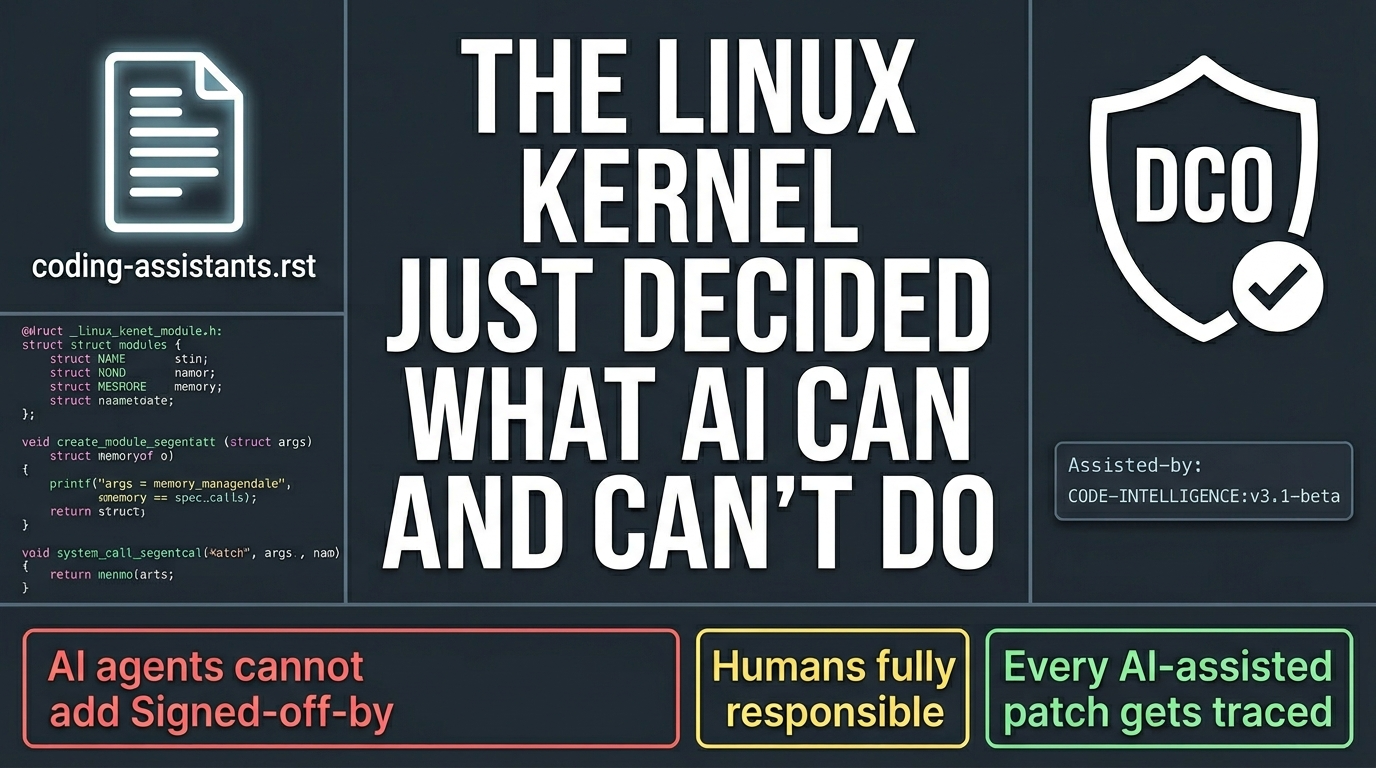
Linus Torvalds merged a document into the Linux kernel today. It is not a joke or a draft. It is the official position of the world’s most important open source project on how AI-assisted contributions work, and it is now live in the kernel tree.
The document is `Documentation/process/coding-assistants.rst`. If you are submitting AI-generated code to any project, including ones you might think are too small to care, this is worth reading. The rules are sharp and they start from a simple premise.
AI agents cannot sign off. Humans must.
The DCO Rule Nobody Can Get Around
The Developer Certificate of Origin is how the Linux kernel tracks legal accountability for code contributions. When you add a Signed-off-by tag to a patch, you are certifying that you have the right to contribute that code, that it is your work or you have authorization to contribute it, and that you understand it will be distributed under the kernel’s licensing. Only humans can do this. No AI agent can legally certify the DCO.
That is the rule. It is not negotiable. The document is explicit: AI cannot hold the legal status required to make the certification. If you submit AI-generated code with your name on it, you are the one who certified it. You own the legal responsibility for everything in that patch.
The implication is straightforward. Before you submit an AI-assisted patch to any project, understand what you are signing. You are not just forwarding what an AI gave you. You are certifying it under your name, your legal identity, and your liability.
The Assisted-by Tag and What It Means
Every AI-assisted patch must include an Assisted-by line listing the agent name, model version, and any specialized tools used. The format looks like this:
“`
Assisted-by: Claude:claude-3-opus coccinelle sparse
“`
The first element is the agent and model. The remaining elements are the specialized analysis tools that worked on the code. Only specialized tools count. Git, gcc, make, and standard editors do not get listed. Coccinelle, sparse, smatch, and clang-tidy do.
This is not bureaucracy for its own sake. The Assisted-by line creates a traceability trail. Every AI-assisted patch in the kernel git log now carries a permanent record of what made it. That record is the first real accountability mechanism we have had at this scale. If a bug lands in a patch that lists Claude Opus 3 and sparse as Assisted-by, the audit trail exists.
Why This Matters Beyond the Kernel
The kernel is the most scrutinized open source project in existence. Its rules for contribution process are the reference implementation that other projects copy. When the kernel writes down how AI contributions work, it sets a precedent that the broader open source world will use.
The document does not treat AI tools as a special case. They are another category of development tool, subject to the same accountability requirements as any other. That framing is deliberate. The kernel maintainers are saying: we are not banning AI-generated code. We are not treating it as inherently suspect. We are treating it like any other contribution and requiring the same human accountability.
If you maintain an open source project, this document is your template. The rules are specific enough to implement and principled enough to adapt. The hardest part of handling AI-assisted contributions has always been the accountability gap. The AI cannot sign. The human must. The kernel just made that official.
What This Changes
For contributors: read this before you submit AI-assisted code anywhere. The rule is the same across any project that uses the DCO. You sign, you own it. That includes licensing compliance, code quality, and any bugs that ship to users. AI does not have a DCO. You do.
For maintainers: the kernel just did the work of figuring out how to handle this. Borrow their framework. The Assisted-by format is a small requirement that creates a large improvement in traceability. When something goes wrong in a patch you merged, you want to know what made it.
The Linux kernel is not slow to change. It is careful. Torvalds does not merge documents that do not reflect the reality of how development works. This document exists because AI-assisted contributions are already happening and the kernel decided to formalize the rules before the problem got worse.
Sources:
– Linux Kernel — Official AI Contribution Rules
– Hacker News Discussion