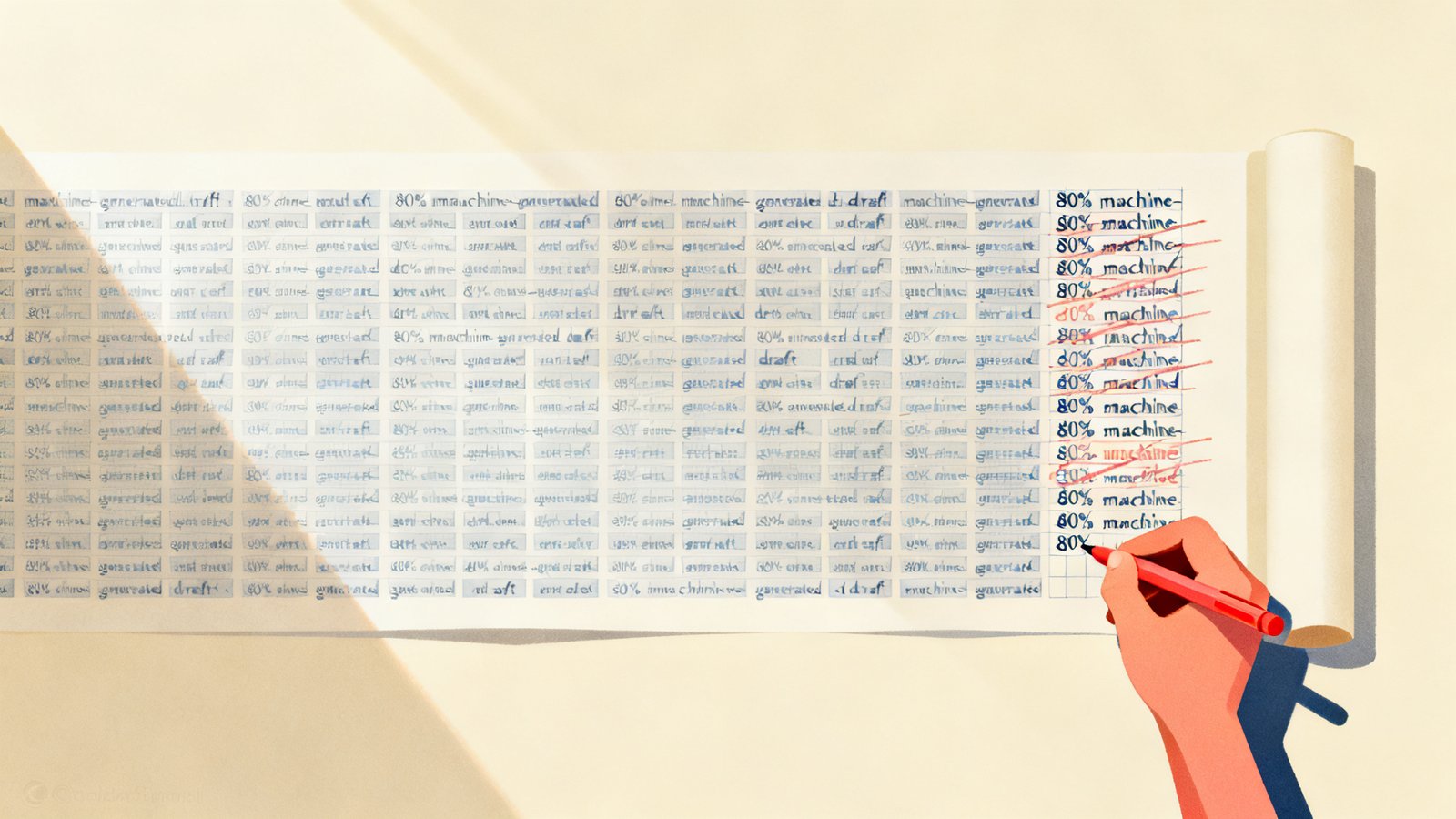
AI tools can generate 80% of your first drafts. That’s not marketing talk. That’s what actually happens when a small team starts using them right. We’ve been doing this for about nine months now and honestly the number tracks. Four out of five blog posts, product updates, email sequences, they start as machine output and get edited into shape by a human.
Here’s what nobody tells you though.
That 80% number isn’t the impressive part. The impressive part is what your team does with the remaining 20%.
How AI drafting works
So the mechanics are pretty straightforward. You feed the model a prompt. Could be a title, an outline, a few bullet points. And it generates a full draft based on patterns it learned from training data. GPT-4, Claude, Gemini, they all work on the same basic principle. Predict the next word. Then the next. Then the next. Until you’ve got a paragraph.
But here’s where it gets useful for small teams specifically. You’re not asking it to write something from nothing. You’re giving it context. Your brand voice. Your product details. A rough structure. The AI fills in the connective tissue.
Side note: the quality of your prompt matters more than which model you use.
A decent prompt on GPT-3.5 beats a garbage prompt on GPT-4.
Every time.
For us the workflow looks like this.
Someone writes a brief — maybe 200 words on what the piece needs to cover.
Drop it into the tool.
Get a draft back in maybe 15, 20 seconds. Then a human spends 30 minutes editing. Total time investment for a 1,000-word blog post drops from four hours to maybe 45 minutes. That’s real. We tracked it.
Benefits for small teams
Small teams feel this differently than big companies.
If you’ve got 12 content writers on staff, sure, AI is a nice efficiency boost.
If you’ve got two people handling all your marketing, communications, docs.
And customer emails — AI drafting is the difference between shipping content and not shipping content.
We’re a team of seven. Before AI tools, our blog published maybe twice a month. Now it’s three times a week. That’s not because we’re working harder. We’re working the same hours. The drafting bottleneck just disappeared.
Some concrete stuff we’ve noticed:
Drafts come out structured.
Like, weirdly structured sometimes.
The AI loves a good intro-body-conclusion format.
Which means even the bad drafts give you a skeleton to work with.
Consistency improves. When the same tool generates your baseline copy, your brand voice stays more uniform across pieces. Different humans edit but the starting point is similar.
Writers block becomes a non-issue. Staring at a blank page is the biggest time waster in content creation. Having a mediocre draft to react to is infinitely better than having nothing. You edit faster than you write from scratch.
That’s just how brains work.
Top AI tools compared
We’ve tried a bunch.
Here’s the honest take on the main ones people are using right now.
ChatGPT from OpenAI.
The default choice. GPT-4 is strong for long-form stuff. Good at following structural instructions. Can be verbose though. You’ll cut a lot of words. The API is reasonably priced if you’re generating at volume.
Claude from Anthropic.
Honestly my personal favorite for writing. Feels less robotic out of the gate. Claude tends to write in shorter sentences and doesn’t lean as hard on filler transitions. The context window is big so you can feed it entire style guides.
Jasper. Built specifically for marketers. Has templates for ad copy, blog posts, social captions. Good if your team doesn’t want to mess with prompt engineering. Costs more though. Like noticeably more. We used it for three months and switched to Claude as the price-to-quality ratio didn’t hold up for us.
Copy.ai. Similar to Jasper but leaner. Cheaper. Fewer templates. Fine for short-form stuff. Social posts, email subject lines, product descriptions. Wouldn’t rely on it for long articles.
Notion AI. This one’s interesting since it lives right inside your docs. No context switching. You’re writing in Notion, hit the AI button, get a draft inline. The quality is a step below dedicated tools but the convenience factor is big for small teams that already use Notion for everything.
Getting started with AI drafting
Don’t overthink this.
Pick one tool. Write five prompts. See what comes back. That’s it.
That’s the getting started guide.
Ok fine, a bit more detail. Start with content types that are lower stakes. Internal docs. Meeting summaries. First drafts of product descriptions. Stuff where if the output is mediocre nobody cares. Build confidence. Figure out what prompts work for your specific voice and industry.
Then move up to external-facing content.
Blog posts. Newsletter sections. Social media captions. Always have a human edit. Always.
The 80% draft is not shippable.
It’s a starting point.
The biggest mistake we made early on was treating AI output as finished work. Published a blog post that was maybe 90% AI generated. Got called out in the comments within an hour. Lesson learned. Now nothing goes out without a full human pass. The AI gets you to 80%.
Your job is the last 20% and that 20% is where the actual value lives.
One more thing. Track your time. Before AI, log how long a typical blog post takes start to finish. After a month of using AI tools, log it again. The numbers will tell you everything you need to know about whether this is working for your team. For us it was roughly a 4x improvement in output per hour. Your mileage will vary but the direction should be the same.
FAQ
Can AI tools really generate 80% of a draft?
Yes, but that 80% needs editing. Think of it as a rough first pass. The structure is usually solid. The specific claims, examples, and voice need human attention. The 80% figure refers to volume of text, not quality of final output.
Which AI tool is best for small teams?
Depends on your needs.
Claude and ChatGPT are the strongest general-purpose options. Jasper and Copy.ai are built for marketing teams specifically. Notion AI is great if you want drafting baked into your existing workflow. For a small team just starting out, I’d say pick ChatGPT or Claude and go from there.
How much do AI drafting tools cost?
Pricing varies by tool and plan. Most offer free tiers to test, with paid options for heavier use. API costs scale with usage. Check each provider’s current pricing directly.
Will AI tools replace human writers?
No. Or at least not for content that matters. What they replace is the blank-page problem. The staring-at-the-screen problem. The getting-started problem. Human writers are still essential for editing, fact-checking, voice, and strategy. AI handles the grunt work of getting words on the page.
Is AI-generated content bad for SEO?
This is a complicated question.
Search engines care about content quality, not just origin.
They penalize bad content. If your AI-generated draft is well-edited, useful, and accurate, it can rank fine. If you’re publishing raw AI output with no editing, that’s a problem. Quality matters more than origin.
Sources
Original post content and statistics are based on team experience over nine months of using AI drafting tools. Tool descriptions reflect publicly available product information as of 2024. Check each provider’s current pricing directly.