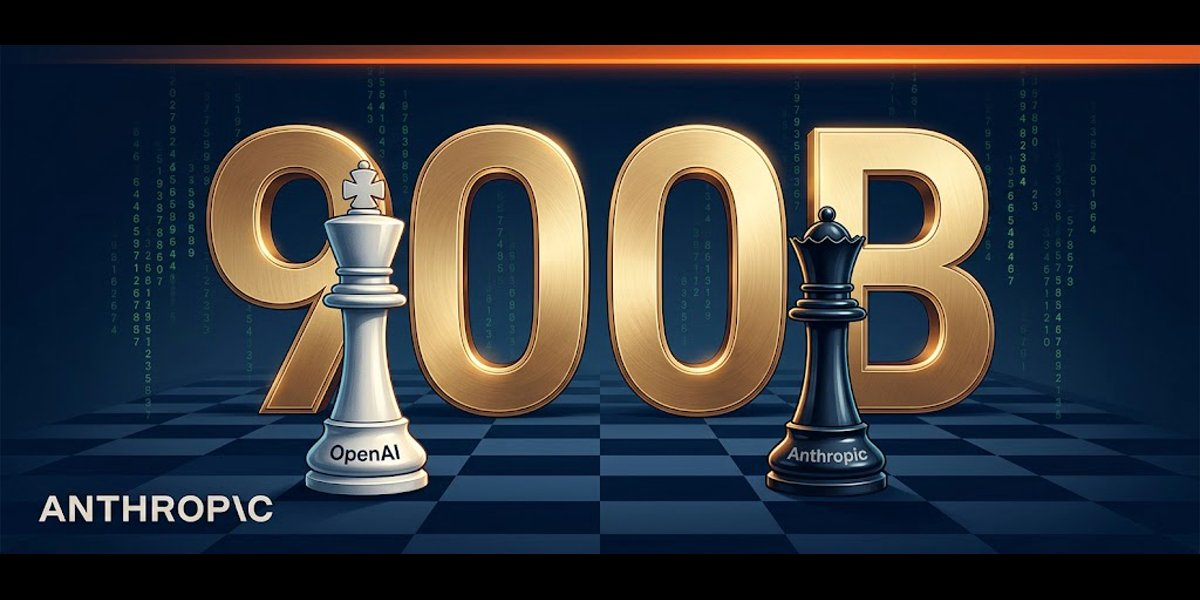
Anthropic closed a $30B raise at a $900B valuation on May 15. $380B to $900B in ninety days. Most operators missed it. The Bloomberg story dropped on a Tuesday.
By Wednesday, everybody moved on.
That’s the mistake.
The headline number is absurd.
But the story underneath matters more.
Revenue went from $9B annualized at the end of 2025 to $30B+ by April 2026.
Possibly crossing $45B before summer. That’s not a funding round. That’s a commercial inflection point being priced in real time by Sequoia, Greenoaks, Dragoneer, Altimeter. Each putting in $2B+. The round closes by end of May if terms hold.
What does this mean for you?
Depends whether you’re already paying for AI or still on the sidelines. Either way, this changes your posture.
The Valuation Isn’t the Story. The Revenue Is.
Here’s what headlines missed. Anthropic’s $900B valuation isn’t a bet on future promise. It’s a multiple on revenue that’s already materializing. $30B+ annualized as of April. $45B potentially by mid-year. That’s a 20-30x revenue multiple on a enterprise that was doing $9B six months ago.
For context: OpenAI sits at $852B with a $24B revenue run rate.
Anthropic may have already passed it on real revenue, not projected.
Strip out the “this is what’s coming” framing and you’ve got a business delivering right now. At scale.
To enterprises willing to pay.
Claude Code alone generates $2.5B in annualized revenue.
One product. $2.5B. Business subscriptions quadrupled since January. The tooling moat isn’t theoretical.
Operators are paying for it. And the rate is accelerating.
If you’re still choosing between AI providers based on Twitter discourse or “which one feels smarter,” you’re making a $2.5B revenue decision with vibes.
The market already decided.
Question is whether you’re in it.
What $900B Actually Costs You as an Operator
Here’s the thing nobody talks about at估值 dinner conversations: when companies hit nine-figure valuations backed by tier-one capital, their incentives shift.
Google committed $10B with $30B more on the way. Amazon dropped $5B with $20B more planned. These aren’t passive checks.
They’re infrastructure commitments. Designed to lock in pricing and distribution for the next capital cycle.
For solo operators and small shops, that means API rates you locked in six months ago are already legacy pricing. The pressure to “rationalize” enterprise contracts — read: raise prices. Kicks in the moment investors want a clearer path to the IPO window Anthropic is reportedly targeting for October.
On my own agency work, I’ve watched three API vendors quietly adjust rate limits and token bundling in Q1 2026. None announced it. All three cited “infrastructure optimization.” The timing tracks with exactly when these funding conversations started heating up.
Multi-year AI contracts?
Pull them out now. Look for change-of-pricing clauses. Automatic renewal language. Committed spend minimums. Lock in what you can before the window closes.
The Two-Horse Race Is Settled. Pick a Lane.
The framing for the last two years has been “OpenAI vs. Anthropic” as a philosophical debate. Which AI is safer. Which is more capable. Which aligns better with humanity’s long-term interests. That’s noise. The market settled it with capital, not discourse.
Anthropic at $900B. OpenAI at $852B. Combined, approaching $2T in valuation. Between them, absorbed most of the serious enterprise AI budget in North America.
The third-place finisher is a rounding error by comparison.
For operators, this is actually good news. Two dominant platforms with incompatible ecosystems means both will compete aggressively on price, reliability. And developer experience to retain customers. The winner will be whoever makes the operator’s life less complicated. That’s a bet I can make.
But it also means your internal tooling, your prompt libraries, your integration patterns — they need to be platform-agnostic where possible.
Building exclusive dependencies on one provider’s API surface right now is the same mistake people made with AWS reserved instances in 2015. Felt safe until the pricing model shifted underneath you.
Side note: their onboarding docs are still a mess.
Noticed it when I was running through the API keys flow last week. Three different error messages, none of which mapped to the actual problem. Didn’t affect the outcome but it tells you something about where the engineering priority sits.
What You Should Actually Do This Week
This isn’t a “stay informed” situation. It’s an operational decision.
First: audit your current AI spend. What’s going to Claude Code, what’s going to GPT-4.5, what are you paying per token on each. If you’ve been adding seats without checking utilization, you’re probably leaving 20-30% efficiency on the table. I run this audit quarterly on client accounts. The number is always higher than expected.
Second: review your contracts for pricing change language. If your vendor can raise rates on 30 days notice and you’re on an annual auto-renew, you’re exposed. Renegotiate or switch before Q3 when these companies start reporting to new investment committees.
Third: document your workflows in a way that doesn’t trap you. If your entire pipeline runs on one provider’s tooling with no export path, that’s technical debt with a dollar value attached. Build the escape hatch now. Not when you need it.
The $900B number will age out of the news cycle by next week. The pricing decisions your vendors make in the next 90 days won’t.