Key Takeaways
– 200 hours of continuous, autonomous operation. No human in the loop.
– 249,560 packages sorted at a facility using humanoid robots.
– Zero hardware failures across the entire run.
– Human workers average roughly three seconds per package. The robots matched that pace.
– The test began as an endurance challenge issued on social media.
—
Humanoid robots. 200 hours. Not a single hardware failure.
Figure AI just ran a 200-hour autonomous shift at its headquarters, sorting nearly 250,000 packages without a human touching the controls.
The run started as a bet on social media. It ended days later, with the robots still running and the internet having named them.
Most coverage is framing this as a robotics milestone.
It is. But the story that actually matters for anyone running a warehouse, a fulfillment operation, or any business that touches physical labor is narrower than that: this is proof the technology works a full shift. Not a demo. A shift.
Here’s why that distinction changes things.
The Benchmark That Replaced the Demo Video
Slick demo videos used to be enough.
Show a robot picking something up smoothly, add some confident voiceover, and you had a funding round. Figure AI just burned that playbook.
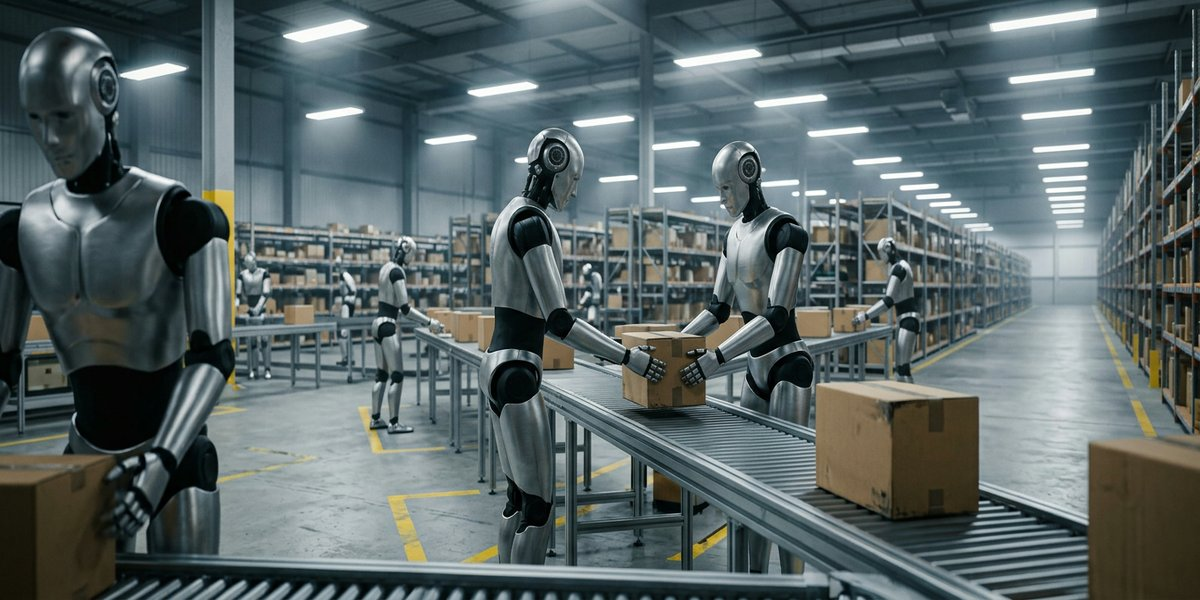
They livestreamed 200 hours of their humanoid robots sorting packages on a conveyor belt. You could watch the robots drop a box. You could watch one take a few seconds longer than expected to orient a package with the barcode facing down. The operation wasn’t error-free — Figure AI confirmed occasional dropped packages and misoriented items. They called those package-handling mistakes, not robot failures.
That distinction matters. A robot that drops one box out of every thousand picks isn’t broken.
It’s performing at roughly the error rate a human new hire would produce in week one.
The demo video era is over. What replaced it is endurance benchmarking. Prove you can work a full shift without being babysat.
Figure AI just set the new standard for what “production-ready” means in warehouse robotics.
What “200 Hours” Actually Means for Logistics Math
Stop thinking about this as a robot story.
Think about it as a labor economics problem.
Humanoid robots. 200 hours. That’s 600 robot-hours over a span of days. If you’re running human workers on rotating 8-hour shifts, those same days require roughly 25 human shifts. Or about three full workweeks of human labor. The robots didn’t clock out for breaks. They didn’t file workers’ comp claims.
They didn’t burn out after 40 hours and need two days off.
The fleet rotation system Figure AI used is worth noting: when a robot’s battery depletes after a few hours, another unit automatically takes its place.
The depleted robot trundles to a wireless charging pad built into the floor and waits. No human intervention required. The system handled fault tolerance autonomously. If a software or hardware issue came up, the robot exits the work floor on its own and a backup unit continues.
For a small warehouse operator looking at a robot fleet, the math is straightforward: one robot works roughly six effective shifts per 24-hour period. Three robots cover multiple shifts. That’s the equivalent of many daily human shifts. With labor costs varying depending on your region and the work. Scale it up and the economics get interesting fast.
The robots sorted at near-human pace.
Roughly three seconds per package, matching what human workers average. That’s not superhuman. That’s parity. And parity at 200 hours without fatigue is the entire value proposition.
The Human vs. Machine Race Tells the Wrong Story
You probably saw the coverage of the side competition. A human worker race against the robot. The human won the sprint. The robot won the marathon. Final tally: something like packages sorted by the human over a period, by the robot in that same window. Then the human went home. The robot kept going for many more hours.
The race is a fun angle.
It’s also a distraction. The interesting question isn’t “can a human out-sort a robot for a short period?” It’s “what does the economics look like when the robot runs for 200 hours straight and the human needs weeks to recover?”
For everyone panicking about warehouse worker displacement: it’s too early for that framing. The robots still drop packages. They still misorient items. The error rate is human-comparable during a single shift. But nobody has deployed a large robot fleet in a real Amazon-scale warehouse yet and published the numbers. Figure AI’s test was controlled. A few robots, one facility, one task. That’s not a supply chain. That’s a proof of concept.
But the trajectory is clear. And for small operators, the window to evaluate this technology before it becomes table-stakes is probably 18-36 months.
After that, if you’re still running pure manual labor, you’re the expensive option in a market that has alternatives.
What Small Operators Should Do With This
Figure AI’s 200-hour run doesn’t mean you need to buy a robot today. It means you need to start watching this space seriously.
The specific numbers worth sitting with: humanoid robots, 249,560 packages, zero hardware failures, 200 hours of autonomous operation. Figure AI used an in-house AI model to enable the fleet rotation and perception stack. That’s proprietary.
Other robotics firms are working toward similar capability but aren’t publishing benchmarks this public-facing.
If you’re evaluating warehouse automation now, here’s what to look at: battery life per robot, autonomous fault recovery (self-exit for maintenance). And whether the robot can orient items correctly in your specific use case — Figure AI was sorting small packages with barcodes.
That may not map to your operation.
The bet that became a long run is a useful frame for how fast this technology moves. A year ago, nobody expected humanoid robots to sustain 200 hours of production. Now one company has published that number publicly. Others will follow.
The window for small operators to get ahead of this isn’t closing yet. But it is narrowing. Watch the pilots. Ask your fulfillment software vendors what robotics roadmap they’re building toward. The robots aren’t coming for your job — they’re coming for your competitors’ cost structure. And that’s a different kind of pressure.
—
Figure AI’s livestream is still running if you want to watch the robots work. The link is on their site. No slick presentation, no voiceover. Just humanoid robots, a conveyor belt, and a counter that keeps climbing.
Watch it. Then decide what your automation strategy looks like for the next 18 months.