Key Takeaways
– Ford’s bet-everything-on-AI quality control strategy imploded. Billions in recalls. Defects everywhere. Course correction took three years.
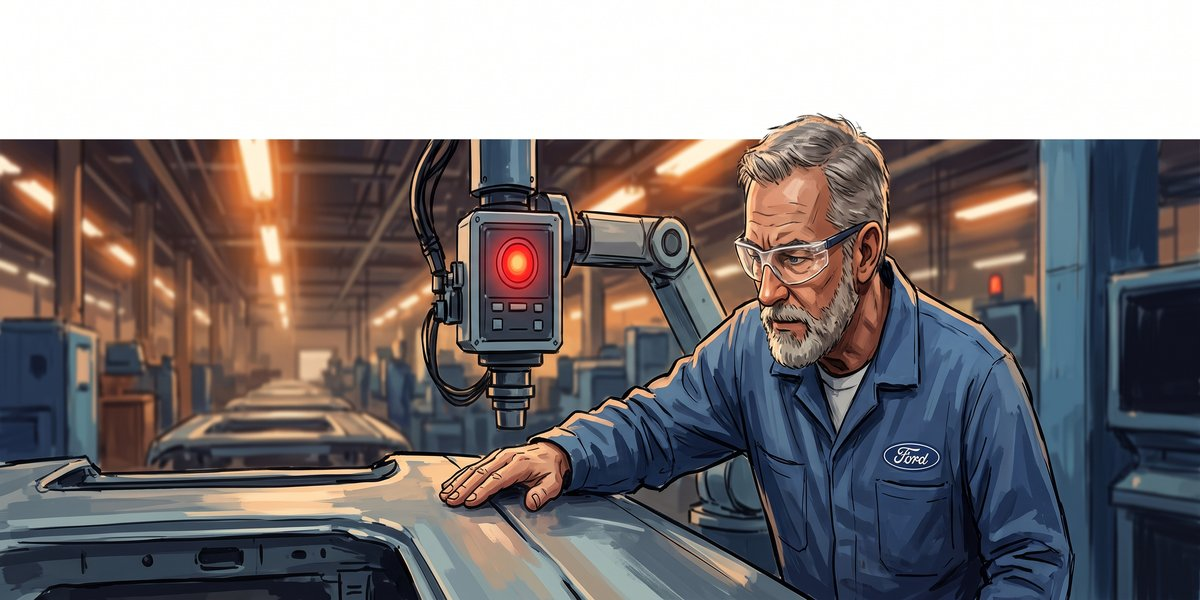
– The company quietly rehired 350+ veteran engineers it had replaced. Bloomberg called them “gray beards.”
– Ford’s own VP said it straight: they “mistakenly assumed that simply integrating artificial intelligence and modifying our design criteria would yield a high-quality product.”
– After bringing the gray beards back, Ford hit #1 among mass-market brands on J.D. Power’s Initial Quality Study for the first time in 16 years.
– The lesson nobody in tech sales will tell you: AI multiplies what your best people know. It does not replace what they know.
—
In 2021, Ford Motor Co. looked at its factories and saw too many humans watching the line.
AI-driven automated inspection systems. Dozens of workstations. The pitch was clean: computers do not tire. Do not miss things.
Do not call in sick.
Someone ran the headcount-versus-compute math.
Machines won.
Three years and several billion dollars in recall costs later, Ford went looking for the humans it had let go.
Bloomberg reported in June 2026 that Ford spent the last three years quietly rehiring more than 350 veteran engineers.
Specialists with deep institutional knowledge. People who had been through multiple vehicle development cycles. The company had replaced them with automated systems and then watched quality fall apart.
Ford’s VP of Vehicle Hardware Engineering, Charles Poon, said it plainly at a press briefing: Ford “mistakenly assumed that simply integrating artificial intelligence and modifying our design criteria would yield a high-quality product.”
That is not a technology failure.
That is a thinking failure.
—
Why Ford’s AI Inspection Systems Failed
Here is what should land for anyone running a business, not just an automaker.
Institutional knowledge is not a dataset. It lives in people who have watched things fail in ways nobody documented. Who have made mistakes that never made it into any database. And developed instincts that no training manual captures.
A veteran quality inspector does not just know what a bad seal looks like. They know what a bad seal sounds like at speed. What it smells like when the line runs hot.
What it feels like when the tolerance is technically within spec but wrong in a way that will surface six months later in a customer’s driveway.
Ford assumed this knowledge could be extracted, encoded into an AI system, and then the humans could go. Poon acknowledged it: some of Ford’s most knowledgeable staff departed before their expertise could be fully captured and onboarded into the automated systems.
The institutional knowledge walked out the door.
The systems that were supposed to replace it did not have enough of the right data to pick up the slack.
I have talked to manufacturing shops running the same experiment right now.
The assumption is always that expertise compresses. It does not. Not the parts that matter.
—
How Ford Uses AI Vision Systems Today
Here is where the story gets more complicated and more useful for small operators.
Ford’s AI vision system — a Mobile Artificial Intelligence Vision System adapted from IBM Maximo — is genuinely impressive. At Ford’s Van Dyke Electric Powertrain Center, the plant was installing an average of 40 electric oil pumps with faulty rubber seals per month in 2023. After deploying the AI vision inspection system, the facility recorded zero “squish tube” defects in April 2024.
That is a real result.
The system is now deployed at 325 workstations across 20 Ford factories globally, inspecting 463 different manufacturing tasks:
– Warping in body panels
– Missing door latch strikers
– Component fit issues
– Uses a mobile phone camera, compares against 30 reference images
– Takes about two seconds to decide whether to stop the line
Ford also built a 40-person software quality assurance team and introduced over 100,000 new AI-driven tests to catch edge cases and stress-test software systems.
So the company is not walking away from AI.
It is deploying it differently — with humans in the loop instead of humans on the way out. The gray beards now mentor younger engineers, lead design reviews. And improve the data used to train Ford’s automated quality systems.
Poon put it this way: artificial intelligence is “a powerful but fallible tool,” and its success depends entirely on the quality of the data used to train the models.
That is a more honest framing than most vendors will give you.
—
AI vs Human Inspectors: Lessons for Small Business
Here is the pattern I keep seeing across every industry right now.
A company hits a productivity wall. Someone runs the numbers on what AI could replace. The business case looks clean on a spreadsheet. The humans get a timeline. The AI system goes live.
And then: edge cases.
Nuanced judgment calls. Situations that do not look like the training data.
The AI handles the obvious stuff well. It always does. The problem is that 80% of what makes a business work is the obvious stuff done consistently, and the other 20%. The weird case. The customer who does not fit the profile. The edge condition that only manifests under specific conditions.
That is where institutional knowledge earns its keep.
Ford is now #1 among mass-market brands in J.D.
Power’s Initial Quality Study for the first time in 16 years. That ranking came after the gray beards came back. Not before.
Do not read this as an argument against AI. Ford is still using AI extensively. Read it as an argument for where AI belongs: handling volume, enforcing consistency, flagging anomalies. But only after your best people have defined what those anomalies look like.
If you are running a lean shop and considering AI tools that would replace someone with real domain expertise, Ford’s three-year, billion-dollar course correction is your evidence that the math does not work the way the vendor promised.
Use AI to multiply what your best people already know how to do. Do not use it to defer the cost of replacing them.
The operators who come out ahead in the next five years are the ones treating AI as a tool for their strongest people, not a substitute for them.
—
Frequently Asked Questions
Did Ford stop using AI for inspections?
No. Ford still uses AI vision systems across 325 workstations in 20 factories. The difference is that humans now work alongside the AI instead of being replaced by it. The gray beards came back and now improve the training data and catch cases the systems miss.
What is the Mobile Artificial Intelligence Vision System Ford uses?
It is an AI-powered inspection system adapted from IBM Maxomo. It uses a standard mobile phone camera, compares what it sees against 30 reference images, and takes about two seconds to decide whether to stop the production line. It caught zero “squish tube” defects in one plant after being deployed.
How many engineers did Ford rehire?
More than 350 veteran engineers, internally called “gray beards.” These are specialists with deep institutional knowledge from multiple vehicle development cycles who had been replaced by automated systems before quality problems emerged.
What happened after Ford brought the veterans back?
Ford hit #1 among mass-market brands in J.D. Power’s Initial Quality Study for the first time in 16 years. The ranking came after the gray beards returned, not before.
—
Sources: Bloomberg (June 25, 2026), The Verge, Carbuzz, Ford press briefing statements via Bloomberg reporting