TL;DR
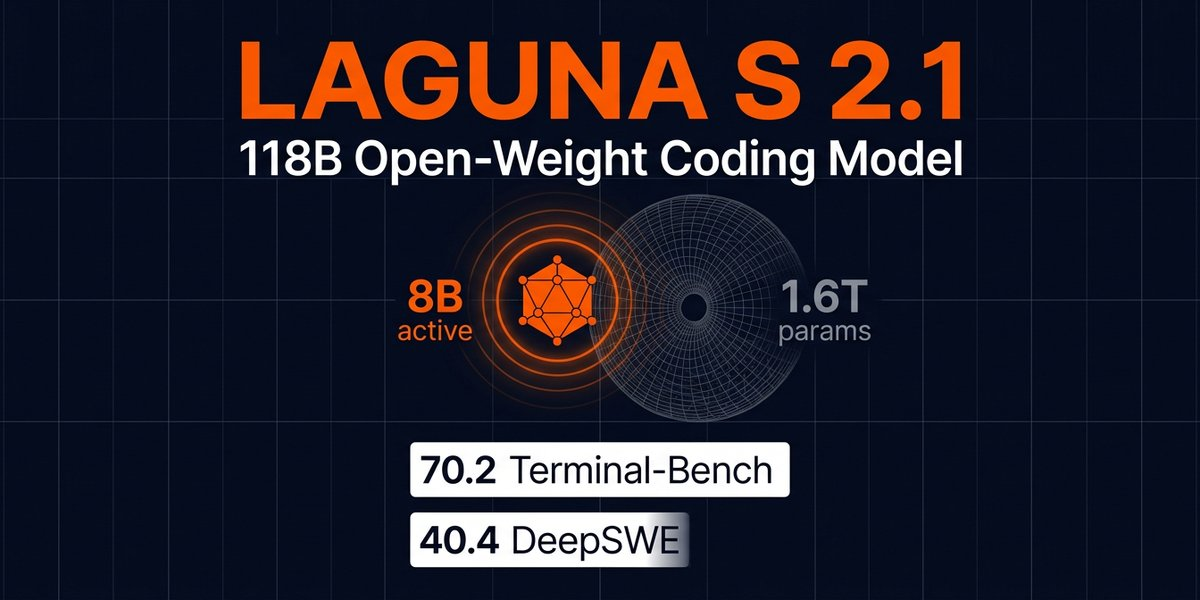
– Poolside Laguna S 2.1 is a 118B-parameter Mixture-of-Experts coding model that activates only 8B per token, outperforming competitors with 5x to 14x its active parameter count on coding benchmarks.
– Released July 21, 2026 as an open-weight model you can download and run yourself.
– Co-founder Jason Warner says the team shipped it 52 days after kickoff, a pace most labs would call impossible.
– The smaller Laguna XS 2.1 (33B total / 3B active) brings the same architecture to local hardware.
Poolside Laguna S 2.1 is a 118-billion-parameter Mixture-of-Experts coding model that activates only 8 billion parameters per token. Released July 21, 2026, it scores just over 70% on Terminal-Bench and nearly 60% on SWE-Bench Pro, matching or beating models from DeepSeek, Nvidia. And Thinking Machines with two to eight times as many active parameters.
It was built from the ground up for agentic coding and long-horizon software engineering tasks. And it ships as an open-weight model you can inspect, download, and run on your own terms.
How Does 8B Active Beat Models 14x Bigger?
Mixture-of-Experts is the architecture doing the heavy lifting here.
Poolside Laguna S 2.1 distributes 118 billion total parameters across specialized sub-networks. But only 8 billion fire on any single token. You get the knowledge capacity of a big model with the inference cost of something far smaller.
That is why commentators describe Laguna S 2.1 as “beating models five to thirteen times its size” on coding benchmarks.
On Terminal-Bench, it scores just over 70%. On SWE-Bench Pro, it hits nearly 60%. Those results put it alongside models from DeepSeek, Nvidia. And Thinking Machines that carry two to eight times as many active parameters. The model is not winning by being bigger. It is winning by being smarter about which parameters it routes to.
Here’s the real kicker. Co-founder Jason Warner said the team went from kickoff to release in 52 days. Under nine weeks for a competitive open-weight coding model. If you have watched AI labs spend months teasing models that arrive late and underwhelm, that timeline should make you question what those teams are actually doing with their headcount.
The model also handles a 1 million token context window. You can feed it big codebases, long debug logs. And extended multi-step reasoning chains without it losing the thread halfway through.
For anyone who has hit context limits during a deep debugging session on a smaller model, that kind of window changes what is possible.
Why Should Small Teams Care About Open-Weight Coding Models?
If you run a small shop or solo consultancy, your coding AI bill is real money. Every API call costs something. And the big proprietary models charge premium rates for capabilities that Poolside just matched for free.
When a coding model ships as open-weight, the calculus changes.
You can download it. You can inspect the weights. You can run it on hardware you control. You can audit how it reasons about your code instead of trusting a black-box API with client deliverables. For agencies handling sensitive client repositories, that is not a nice-to-have feature. It is the difference between using AI tools responsibly and using them blindly.
The economic argument compounds quickly.
Poolside describes Laguna S 2.1 as “the most capable agentic coding model in its weight class,” and on SWE-Bench Multilingual, it matches or beats considerably larger models, including both open and proprietary coding agents. When an 8B-active model outperforms competitors with 5x, 6x, even 14x its active size, you have to ask what you are actually paying for when you write a check to a proprietary API provider.
The Laguna family gives you deployment options, too. Poolside too ships Laguna XS 2.1, a 33B total / 3B active variant built for local machines. It scores 63.1% on SWE-Bench Multilingual, a 5.4-point improvement over the previous XS.2 generation.
If your hardware cannot handle the full S model, the XS line is a legitimate starting point, not a watered-down toy.
What Did Poolside Get Right That Bigger Labs Didn’t?
Speed is the obvious answer.
Fifty-two days from kickoff to release is not a team that spent six months on a teaser campaign. It is a team that built, trained, evaluated, and shipped. That cycle time tells you something about how the organization is run. And it should embarrass labs with ten times the resources producing a fraction of the output.
But the deeper win is the model class itself. Laguna S 2.1 is explicitly designed for agentic coding and long-horizon software engineering, including complex multi-step programming and debugging workflows. This is not a general-purpose chatbot that happens to write code when you ask nicely. It was engineered from the ground up for software engineering, and the benchmark scores reflect that specialization.
The efficiency story is what should worry the competition.
An 8B-active model beating competitors 5x, 6x, even 14x its active size means the parameter-count arms race has a serious counter-narrative. Bigger is not automatically better. Smarter routing through a Mixture-of-Experts architecture is delivering real results at a fraction of the compute cost. And that math matters enormously when you are the one paying the compute bill.
What Should You Do With Laguna S 2.1 This Week?
Stop paying premium API prices without benchmarking the open-weight alternatives. Download Laguna S 2.1, run it on the kind of tasks your developers actually handle day to day. And compare the output quality to whatever proprietary model you currently pay for. If your hardware cannot support 118B total parameters, grab Laguna XS 2.1 instead and test whether its 63.1% SWE-Bench Multilingual score covers your workload.
The open-weight ecosystem just produced a coding model that trades blows with the biggest names in AI.
You owe it to your budget to find out if it works for you.
Sources
– Poolside AI: Introducing Laguna S 2.1
– AIBites: Poolside Laguna S 2.1 118B Open-Weight Code Model
– Jason Warner on X
– AIMadeTools: Laguna S 2.1 Complete Guide
– Poolside AI: Introducing Laguna XS 2.1