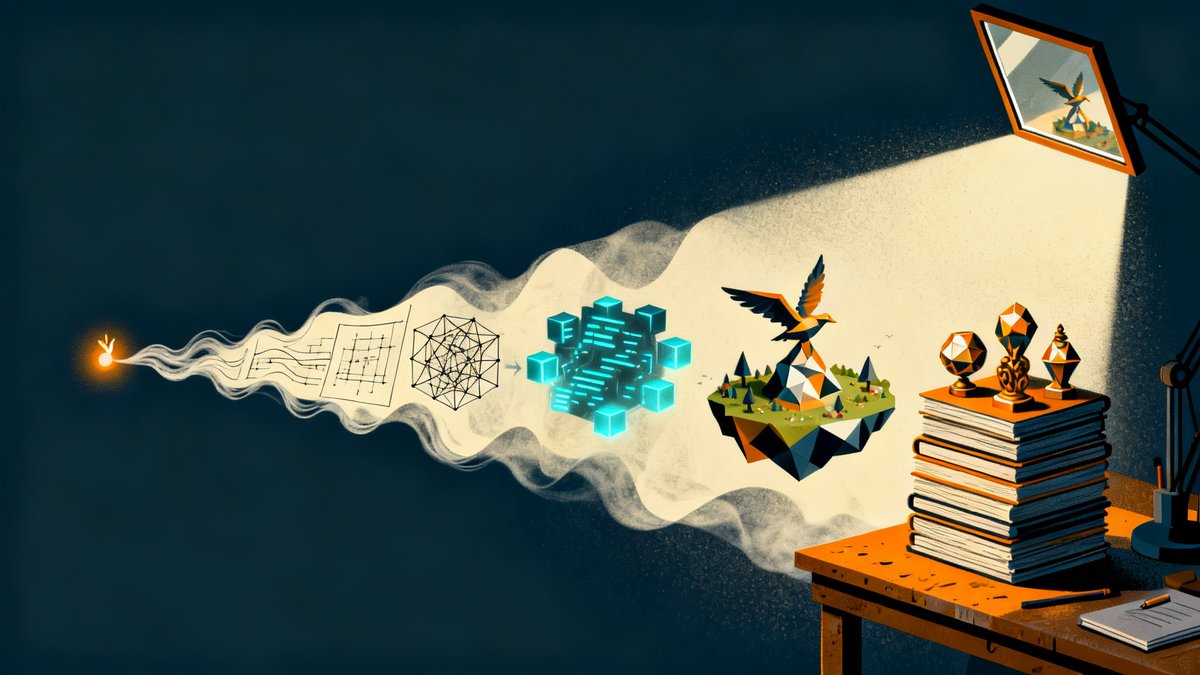

DeepSeek shipped DeepSeek-V4.1-Flash-1017 on October 17, 2026, and posted the weights for anyone to download. The announcement is titled “Wish-Driven Programming Made Real,” and that title is the whole strategy: you describe the finished project.
And the model builds it end to end.
Here is the short version if you are deciding whether to care. DeepSeek V4.1-Flash-1017 is an open-weight coding model update, live now on DeepSeek’s website, app. And API, with weights on Hugging Face and ModelScope. The architecture is unchanged from the earlier V4.1-Flash: a 552-billion-parameter backbone, 8 billion parameters active per input token, 16 billion active per output token, a one-million-token context window. And native image understanding, per a technical summary that also puts the new post-training at five extra weeks. The target of that training is end-to-end project development, from game creation to 3D modeling. DeepSeek claims stronger benchmark performance, faster task completion. And shorter outputs than the previous version, calling it “a Pareto improvement in performance and cost.”
Same Backbone, New Training: What Actually Shipped
The 1017 suffix lines up with the October 17 release date.
And that tells you what kind of drop this is.
It is a snapshot release: same model family, refreshed weights, new behavior. The summary confirms the snapshot keeps the same Causal Encoder-Decoder architecture as the earlier V4.1-Flash, so nothing structural moved.
What you get instead is a multimodal mixture-of-experts model, as NVIDIA’s model page describes it: text and image input, autoregressive text output, a combined context of up to one million tokens. And continuously controllable reasoning effort.
That last part matters more than it sounds. Because it is a knob you can turn per task instead of a fixed personality you have to work around.
The interesting takeaway for operators is what this says about how capability ships now. When the architecture does not move, training is the product. DeepSeek is delivering improvements as post-training rounds on a fixed backbone, which means a model under a familiar name can behave differently after each snapshot. Build accordingly.
The sparse activation is the economic trick here. Only 8 billion parameters fire per input token and 16 billion per output token, out of a 552-billion-parameter backbone. So the per-token compute behaves closer to a small model than a half-trillion one. The full backbone still has to sit in memory if you self-host, which is the trade you accept for open weights.
The Self-Feedback Loop, and Why Shorter Outputs Matter
The training story is the interesting part. Per the summary, the model attempts an end-to-end project, grades its own output against the goal. And iterates on the difference. Five extra weeks of that produced this snapshot. In most agent setups, the grading step lives outside the model, in agent scaffolding or a test suite you write.
DeepSeek pulled it inside the model.
My skepticism flag goes up on one point.
A model grading its own homework is convenient. And every number in the announcement is DeepSeek’s own. “Stronger benchmark performance” arrives with no independent verification attached. So treat it as a vendor claim until third-party results exist. I have watched vendor-run numbers age badly too many times to route production traffic on launch-day claims.
The sleeper claim is “shorter outputs,” and I would verify that one first.
Most model releases brag about doing more; this one brags about writing less while finishing faster. For agent pipelines, output length is the bill and the wait at the same time, since you pay per token and you sit there while it streams. A Pareto improvement in performance and cost means better on both axes rather than trading one for the other. And shorter output is where most of that cost improvement hides.
Wish-Driven Works Best on Greenfield
Look at the examples DeepSeek chose: game creation and 3D modeling.
Both are greenfield projects with a visible finish line, where “done” is something you can see.
A game either runs or it does not. A 3D model either renders or it does not.
End-to-end generation genuinely holds in that territory, and that is exactly why the demo examples are what they are.
Most work for a small operator is the opposite of greenfield. It is migrations, bug fixes in an unfamiliar codebase, and integrations with an API someone else controls. A wish describes an outcome; production code has to respect everything that already exists, including the parts nobody documented. My routing advice is simple: send greenfield scaffolding at this model first. And treat anything that touches existing systems as review-heavy work regardless of what the release notes promise.
The tooling notes in the announcement back this up.
DeepSeek says the model is optimized for DeepSeek’s agent tool, Tencent CodeBuddy. And WorkBuddy, and recommends upgrading to DeepSeek’s agent tool v0.2.1-rc.1 or later for the best experience. “Optimized for” named tools means the headline experience assumes their stack, so before you blame the model for a bad run, check your tool version.
The controllable reasoning effort knob is your friend on the harder tasks, where you spend more compute per attempt in exchange for fewer attempts.
What You Should Actually Do With This
This is a test-don’t-trust release. And the tests are cheap given that the model is already live on the website, app, and API.
Here is the sequence I would run.
– Record the exact snapshot you test. When the next post-training round lands under a new suffix, re-run your evaluation before production traffic follows it, as behavior under the same family name is not guaranteed to hold.
– Pull the weights from Hugging Face or ModelScope, or hit the API, and run your worst real task rather than a demo prompt. Measure output length and completion time against your current model, since those are the two claims DeepSeek made.
– Upgrade to DeepSeek’s agent tool v0.2.1-rc.1 or later if you use it, and confirm your tool is on the optimized list before comparing results.
– Discount the benchmark claims until someone independent reproduces them. Vendor numbers are a starting hypothesis, not a conclusion.
The ownership angle is the quiet win here.
Open weights mean you can run this on hardware you control.
And no vendor can pull the model out from under you or change the price of your pipeline overnight.
Self-hosting a 552-billion-parameter backbone is real infrastructure, and most solo operators will use the API anyway.
The option still changes your negotiating position, and with closed models you never get the option at all.
Strip the marketing and the news is narrow and useful: same architecture, five more weeks of training tuned to finish projects with less text, weights free to download.
That is a genuine upgrade for greenfield automation and a prove-it-first case for everything else.
Run one real project through it this week and keep the receipts.
If you want more teardowns like this one, subscribe, since the next snapshot will land before the reviews of this one finish.