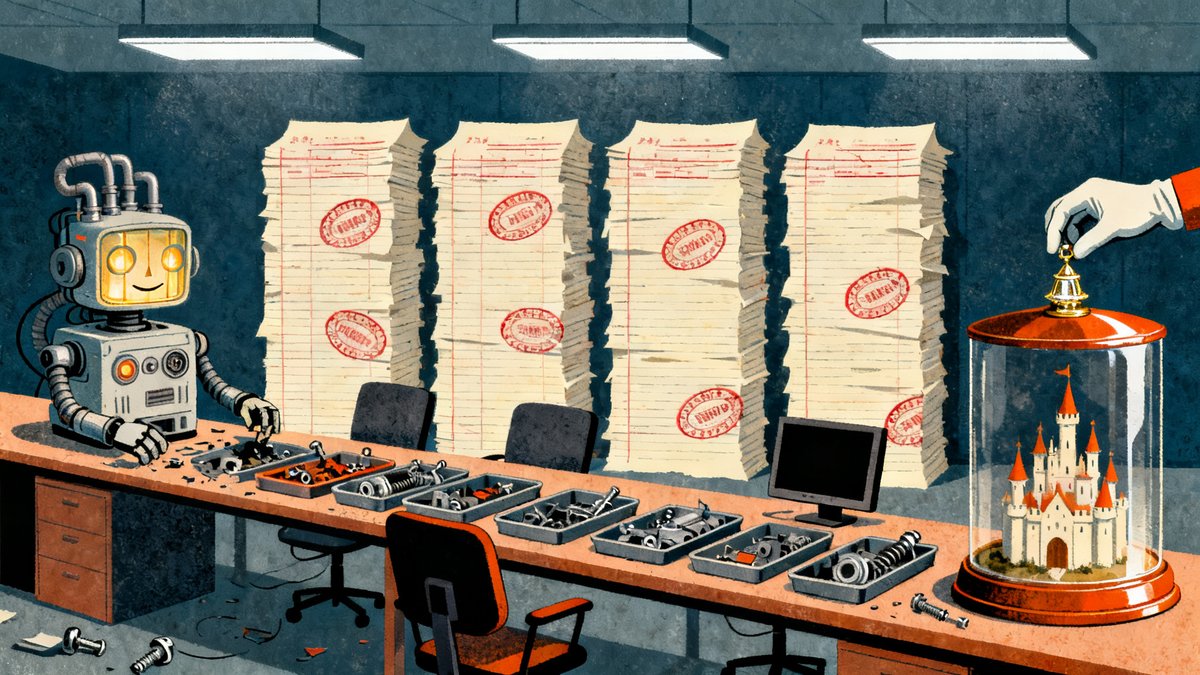
Character.AI filed Chapter 11 owing between $50 million and $100 million. And the lead bid for the estate is $20 million. That gap is the whole story. One of the first breakout products of the generative AI boom is five years old. And it’s now being sold in pieces through a court-supervised process where the opening bidder, Disney’s Disney Worldwide Services, isn’t buying the company at all.
Here is the deal on the table, in one paragraph: $20 million for certain assets, plus a non-exclusive, perpetual license to some of Character.AI’s intellectual property, with transition support provided by former Character.AI employees Disney already hired (CNBC, TechCrunch). The platform keeps running during the sale, paid subscriptions included. And the company expects the process to close in late November or early December 2026 (The Verge). If no buyer arrives with a workable plan to continue operations, chief executive Colin Adams said in the announcement, “the platform will be wound down.”
What The Filing Actually Says
Character Technologies told the bankruptcy court it has assets and liabilities each in the range of $50 million to $100 million (TechCrunch). The Chapter 11 structure exists so the company can keep operating while a court supervises the sale of its assets (Los Angeles Times). Management says it expects minimal disruption in the meantime, with subscriptions staying available (CNBC, The Verge).
Now read those two paragraphs together.
A $20 million stalking-horse offer is sitting on top of liabilities that start at $50 million. And Adams himself noted there isn’t yet a bid or a buyer beyond the proposed Disney arrangement (TechCrunch). The remaining assets go into the sale process and a potential auction, subject to higher or better offers under Section 363 of the U.S. Bankruptcy Code, so $20 million is a floor, not a verdict on what the technology is worth (The Verge). Today, the floor is the entire offer sheet.
That tells you who is really paying for the last five years. The sale proceeds go to an estate whose liabilities run two and a half to five times the opening bid. Somebody is eating the difference, and it isn’t Disney.
Disney Isn’t Buying The Company
A stalking-horse bid is an opening offer that sets the baseline for competing bids (The Verge). What Disney gets for its $20 million is selected assets and IP, not the whole business (The Verge). The license is non-exclusive and perpetual (TechCrunch), which matters more than it sounds: the estate can license the same technology to other buyers later. Disney bought rights, not a moat.
The transition-services clause is the tell.
Disney agreed to provide transition support “using former Company employees it has hired” (The Verge). And TechCrunch reports those employees joined Disney the month before the filing, alongside former CEO Karandeep Singh Anand. Engadget notes the company had already lost key talent to Google on top of that (Engadget).
My read: this is an acquihire wearing a bankruptcy costume.
The people left the building first, the paperwork followed. And now the court is selling what’s left on the shelf. That’s a legitimate strategy, but call it what it is. When the operators of a five-year-old AI company are already on the buyer’s payroll before the auction opens, the auction isn’t actually about finding a savior for the platform.
How A Five-Year-Old Darling Ends Up Here
Character.AI was founded in late 2021 by former Google engineers Noam Shazeer, a co-author of the landmark Transformer paper.
And Daniel De Freitas (TechCrunch).
The product is exactly what it sounds like: users create AI characters and converse with them. The Verge described it as one of the first breakout startups of the generative AI boom (The Verge).
Then came what TechCrunch called “a slew of lawsuits and struggles to scale its popular platform” (TechCrunch). The Los Angeles Times reports the company faced lawsuits alleging that chatbots created on the platform harmed teenagers’ mental health, along with copyright infringement claims over the virtual characters users create (Los Angeles Times).
Those are allegations, not adjudicated findings.
But the pressure was obviously real enough to help push the company into court.
Notice what’s missing from that causal chain: nobody claims the product failed to attract users. Popularity was never the problem. A chat product where every additional user generates additional inference cost and additional legal surface area scales its problems as fast as its audience. Attention is not a business model, and neither is engagement. I’ve watched this pattern from the builder side for years: the demo is cheap, the marginal user is not. And the lawsuit arrives long after the growth chart looks impressive.
What This Means For You If You Build On Other People’s Platforms
The most important sentence in this entire filing for a small operator isn’t the $20 million. It’s “the platform will be wound down.” That is the documented base case for a platform with millions of conversations on it, stated by its own CEO. Plan accordingly, on every dependency you don’t control.
– Run an export today, not at the deadline. If your work, your users’ data, or your chat history lives on a third-party AI platform, treat wind-down as a real scenario and get a local copy while the service is still up.
– Read what happens to data and billing in an asset sale. A bankruptcy sale transfers assets; it doesn’t automatically transfer the relationship you thought you had. Know the terms before you’re reading them under deadline pressure.
– Price above your per-message cost. If every user interaction costs you money at your provider, your subscription has to clear that cost with room to spare. Products that scale their costs with their popularity need pricing that scales with them.
– Don’t tie yourself to one model vendor. Character.AI’s own filing shows how fast the ground moves. In my own builds I keep a working fallback for any API I depend on, because the cost or availability terms can change without asking me.
The auction clock runs to late November or early December 2026. And any higher or better offer under Section 363 can displace Disney’s bid (The Verge). Watch whether a real buyer for the platform appears, since that’s the only outcome where “minimal disruption” stays true.
Until then, treat this as the cleanest data point you’ll get this year on what a beloved AI product is actually worth when the bills come due: parts, licenses. And the people were already gone.
Go export your stuff from any AI platform you can’t afford to lose.
Then check what your own product would be worth sold for parts.
And fix that while you still control the terms.